Welcome to My Broken Heart Blog.
This entry is another stop on a long journey.
I am definitely learning patience as a result of this adversity.

Patience (pā-shəns) is the ability to endure adversity without irritation.
Also steadfast, diligent, steady perseverance.

Today, my parents and I went to see Dr Magnano at
Diagnostic Cardiology Associates (also Dr Constantin's group)
about the results of the t-wave test I had on Monday.

Dr Anthony Magnano ("The Electrician")
The t-wave alternans test was negative (the results we wanted) so I do not have an increased risk of sudden heart failure from cardiac arrythmia. Those who are found to be at high risk would therefore benefit from the placement of a defibrillator device which can stop an arrhythmia and save the patient's life. The test examines the t-wave of the EKG or the measurements of the heart's electrical conduction. See diagram below.
The test was very simple and non-invasive stress test. Twelve leads were attached to my chest and midsection (after the nurse roughed up my skin with sandpaper at each lead site - OUCH!). Then I walked at a slow pace on a treadmill for approximately seven minutes. The leads fed data to a monitor that recorded the electrical wave patterns of my heart. The computer analyzed the data and issued its finding - My results were negative.
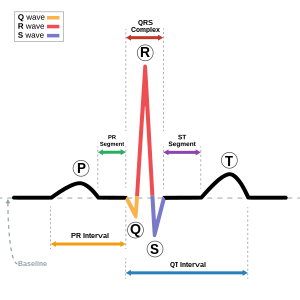
T-wave alternans testing acts as a risk stratifier between patients who need implantable cardiac defibrillators (ICDs) and those who do not. Patients who test negative for t-wave alternans are LESS likely to require a defibrillator than those who test positive.
Dr Magnano, nicknamed "The Electrician" by Dr Constantin, explained that my "electronics" are stable and my heartbeat is regular. If my t-wave alternans test was positve, a defibrillator would have been ordered immediately. Because of my age, both doctors are cautious of implanting this "machine" too soon, but they are very concerned about my low ejection fraction - still below 20%. Basically, my blood flow is good, my electronics are good, but my "ticker" is weak and can't push the blood at a healthy rate. Both doctors believe I will continue to improve as they slowly increase my medications.

I am gradually getting stronger and my stamina is increasing. The picture about was taken during a trip to Jacksonville Beach for dinner at Tacolu with my friend Toni. Lately, I move easier, with less effort, and my heart is not as stressed as before. For example, after helping my father give my dog Brutus a bath this week, I was tired, but not out of breath or palpitating.
I have had outings to First Friday in Five Points (below right)
and the Jacksonville Zoo and Gardens
(new Bamboo Gardens are a must see, below left).


I am still monitoring my sodium intake - learning about food along the way.
I am trying to move into the new Whole Foods - I hate leaving that place.

Get the Salt Out: 501 Simple Ways to Cut the Salt Out of Any Diet
by Ann Louise Gittleman
In this day and age, when fat is blamed for all our health problems, it's often easy to forget that salt can also be a dietary culprit. While salt is necessary for both bodily and cellular function, and is certainly crucial to the satisfying taste of some of our favorite foods, recent research shows that its excess consumption can also lead to hypertension, strokes, and a variety of cardiovascular problems.
In Get the Salt Out, nationally recognized nutritionist Ann Louise Gittleman reveals 501 ways to avoid excess salt intake by serving a variety of delicious low-sodium foods, taking advantage of tasty salt substitutes and steering clear of many surprising hidden sources of salt. She provides more than fifty delicious recipes for low-sodium foods, which will add healthful new staples to the diet of anyone who wants to "get the salt out."
Get the Salt Out has all the tips, menu plans and recipes to help you enjoy real foods again and create meals that both your taste buds and your body can truly savor!
In Get the Salt Out, nationally recognized nutritionist Ann Louise Gittleman reveals 501 ways to avoid excess salt intake by serving a variety of delicious low-sodium foods, taking advantage of tasty salt substitutes and steering clear of many surprising hidden sources of salt. She provides more than fifty delicious recipes for low-sodium foods, which will add healthful new staples to the diet of anyone who wants to "get the salt out."
Other features include:
¸ Advice on how to use herbs effectively to reduce sodium intake
¸ Tips for reading labels to expose salt where it is hidden as well as supermarket salt savvy
¸ Ways to reduce the salt level in your water
¸ Advice for avoiding salt when you eat out
¸ Tips for dealing with stress and other impediments you may face
¸ A week-long menu plan
¸ A resource section
¸ Advice on how to use herbs effectively to reduce sodium intake
¸ Tips for reading labels to expose salt where it is hidden as well as supermarket salt savvy
¸ Ways to reduce the salt level in your water
¸ Advice for avoiding salt when you eat out
¸ Tips for dealing with stress and other impediments you may face
¸ A week-long menu plan
¸ A resource section
Get the Salt Out has all the tips, menu plans and recipes to help you enjoy real foods again and create meals that both your taste buds and your body can truly savor!
ISBN:9780517886540
- Author: Gittleman, Ann Louise
- Publisher: Three Rivers Press (CA)
- Subject: Salt-free diet
- Publication Date:December 1996
- Binding: Paperback
- Pages: 240

Found this tattoo online - thought it was very appropriate.
NEXT UPDATE: June 30, 2009
Appointment with doctors regarding progress.

To my loved ones, friends, and colleagues.
Thank you for your love and support.
I could not have made it this far without you.


.svg.png)